

Wheel Hub Bearing Supplier
ENRO is sourcing wheel hub bearings and wheel hub assemblies (wheel bearing hub assemblies) for passenger cars and light trucks, under the same QC and inspection protocol used across the ENRO range.
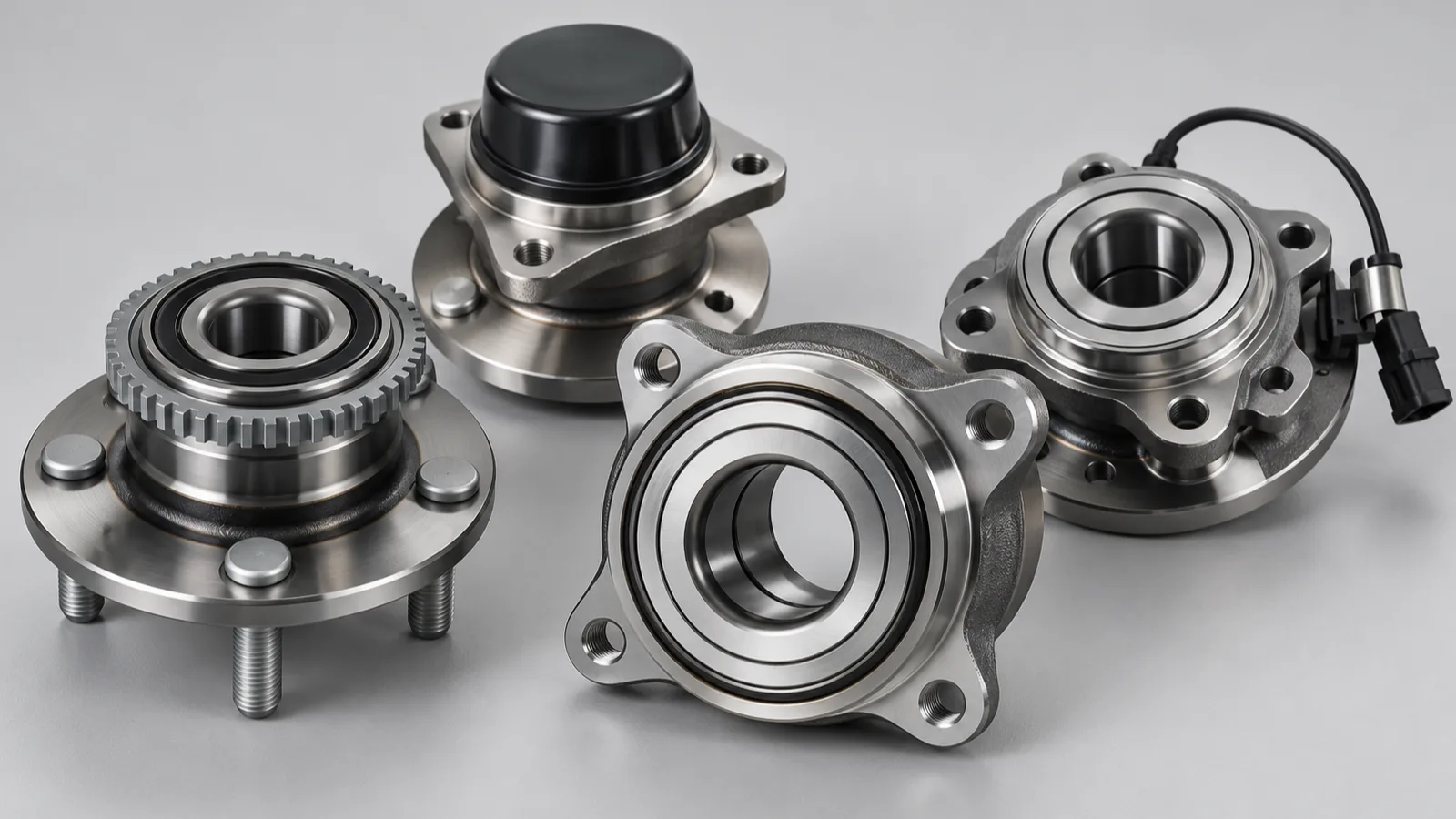
What is a wheel hub bearing?
A wheel hub bearing is the bearing that lets a vehicle’s wheel rotate on its axle while carrying the vehicle’s weight and the side loads from cornering and braking. On most passenger cars and light trucks built since the 1990s it is sold as a wheel hub bearing assembly (also called a hub unit or wheel hub assembly): a sealed, pre-greased cartridge that combines the rolling-element bearing with the wheel hub flange, and on many models an ABS tone ring and sensor, in one bolt-on part.
Engineers group hub units into three generations. Generation 1 is a separate bearing pressed into a hub the vehicle maker supplies; Generation 2 adds the hub flange to the bearing but still needs the knuckle and ABS sensor fitted separately; Generation 3 integrates the flange, the ABS sensor ring and the mounting bolts for the brake rotor or drive axle into one sealed unit. Most current front-wheel-drive cars use Generation 3 hubs at all four corners.
- Takes combined radial load (vehicle weight) and axial load (cornering) at the same time.
- Sealed and pre-greased for life; designed for no routine maintenance.
- Bolts directly to the steering knuckle or axle housing, so the whole unit is replaced together.
- On driven wheels the hub bore is splined to take the drive shaft; on non-driven wheels it is a plain bore.
Wheel bearing, hub assembly, hub bearing: same part, different names
Buyers search for this part under several names that all point at the same component: wheel bearing, wheel hub bearing, wheel hub assembly, hub unit, and in trade catalogs, wheel bearing hub assembly. Some listings separate a bare wheel bearing (the rolling-element cartridge only, used in the older Generation 1 design) from a wheel hub assembly (bearing plus hub flange, Generation 2 or 3). When ordering, what matters is the vehicle application and whether ABS is fitted, not which of these names is used.
Bearing supplier China: Japan-managed QC, 100% outgoing inspection
ENRO is a bearing brand for distributors and MRO buyers. The brand sets the specification, the inspection protocol and the packaging, and it answers for every unit that ships under its label. Your inquiry goes straight to the export team, not a call center.
Every ENRO bearing is Made in China, produced at partner factories in China to the ENRO specification. We say so on every page rather than hiding it behind a flag, because the origin is not the point: the checking is. A bearing supplier in China can be anything from a trading desk to a brand with its own protocol; ENRO is the latter, and the model pages show the data you can hold us to.
Japan-managed quality control means the protocol is written to Japanese industrial quality practice and applied at the partner factory: dimensions checked against the model page, then 100% outgoing inspection. Every ENRO bearing — not a sample, every unit — passes outgoing inspection before shipment. Every ENRO bearing carries a verifiable anti-counterfeit label.
ENRO sells on published data: every model page lists boundary dimensions, the versions offered and catalog ratings where confirmed, so you can check the part before ordering. We compete on consistency, not slogans.
Standards and checks that carry over to wheel hub bearings
Built to be checked, not believed. Boundary dimensions follow the ISO 15 dimension series. Ratings follow ISO 281 and clearance groups ISO 5753-1; every value on a model page can be checked against the standard.
Boundary dimensions
Boundary dimensions follow the ISO 15 dimension series. Same base number, same d, D and B.
Tolerances
Defines the tolerance classes for radial bearings. State the class you need on the RFQ.
Internal clearance
Defines the clearance groups C2, CN, C3, C4 and C5. State the group you need on the RFQ.
Rating life
Basis of the L10 basic rating life. Use it with the catalog Cr in our life calculator.

Japan-managed quality control
ENRO is a bearing brand for distributors and MRO buyers. Our QC protocol follows Japanese industrial quality practice. Our bearings are made in China.

100% outgoing inspection
Every ENRO bearing — not a sample, every unit — passes outgoing inspection before shipment.

Same color, same box, same label
Every order ships in the same color box with the same label, so repeat shipments match on the shelf.
Wheel hub bearing cross reference table
The wheel hub bearing cross reference table lists DAC numbers next to the part numbers other bearing brands and vehicle makers use for them, the catalogue unit weight, and the vehicle application where the catalogue names one. It matches by part number, not by boundary dimensions, so it is not a size table. Find your number or your vehicle there, then send it with the full vehicle application below and the export team will confirm the match, the price and the lead time directly.
Wheel Hub Bearing FAQ
Where are ENRO bearings made?
ENRO bearings are Made in China by partner factories, under Japan-managed quality control. Every unit passes 100% outgoing inspection before shipment.
What information do you need to quote a wheel hub bearing?
The vehicle make, model, year and drive position (front or rear, left or right where the part is side-specific), or the OE or aftermarket part number if you have it. Send it with the quantity and ENRO will confirm the match before the sample ships.
How fast do you reply to an inquiry?
We reply within 24 hours on business days. Your inquiry goes straight to the export team, not a call center.
Do you provide samples?
Free samples are available.
What are your payment terms?
Payment terms are as set out in the sales contract.
Can you match a part number from another brand?
Send any part number and we'll match the dimensionally equivalent ENRO model. Matching is by boundary dimensions only (dimensionally interchangeable).
Send your wheel hub bearing application
We reply within 24 hours on business days. Your inquiry goes straight to the export team, not a call center.