
Deep Groove Ball Bearing Double Row
Deep Groove Ball Bearing Double Row: the short answer
A double row ball bearing has two rows of balls in one set of rings. It carries more radial load than a single-row bearing of the same bore and OD, at the cost of a wider section. It fits where one bearing must carry a heavy combined load on a short shaft; a single row bearing is the better choice at speed and in most motors, pumps and hubs. ENRO lists single-row deep groove ball bearings only, in series 6700, 6800, 6900, 6000, 6200, 6300, 16000, 6400, and a single row size shares the bore and outside diameter of its double row counterpart.
Key takeaways
- Double row designs trade width and speed for radial capacity; single row designs cover most motors, hubs and pumps.
- A 42 or 43 series double row bearing has the same bore and outside diameter as the 62 or 63 series single row bearing with the same last two digits; only the width differs.
- ENRO lists 200 single-row sizes from 10–160 mm bore.
- If your drawing calls for a double row bearing, send the part number and we will tell you whether a single-row ENRO size fits the same envelope.
How does a double row deep groove ball bearing differ from a single row?
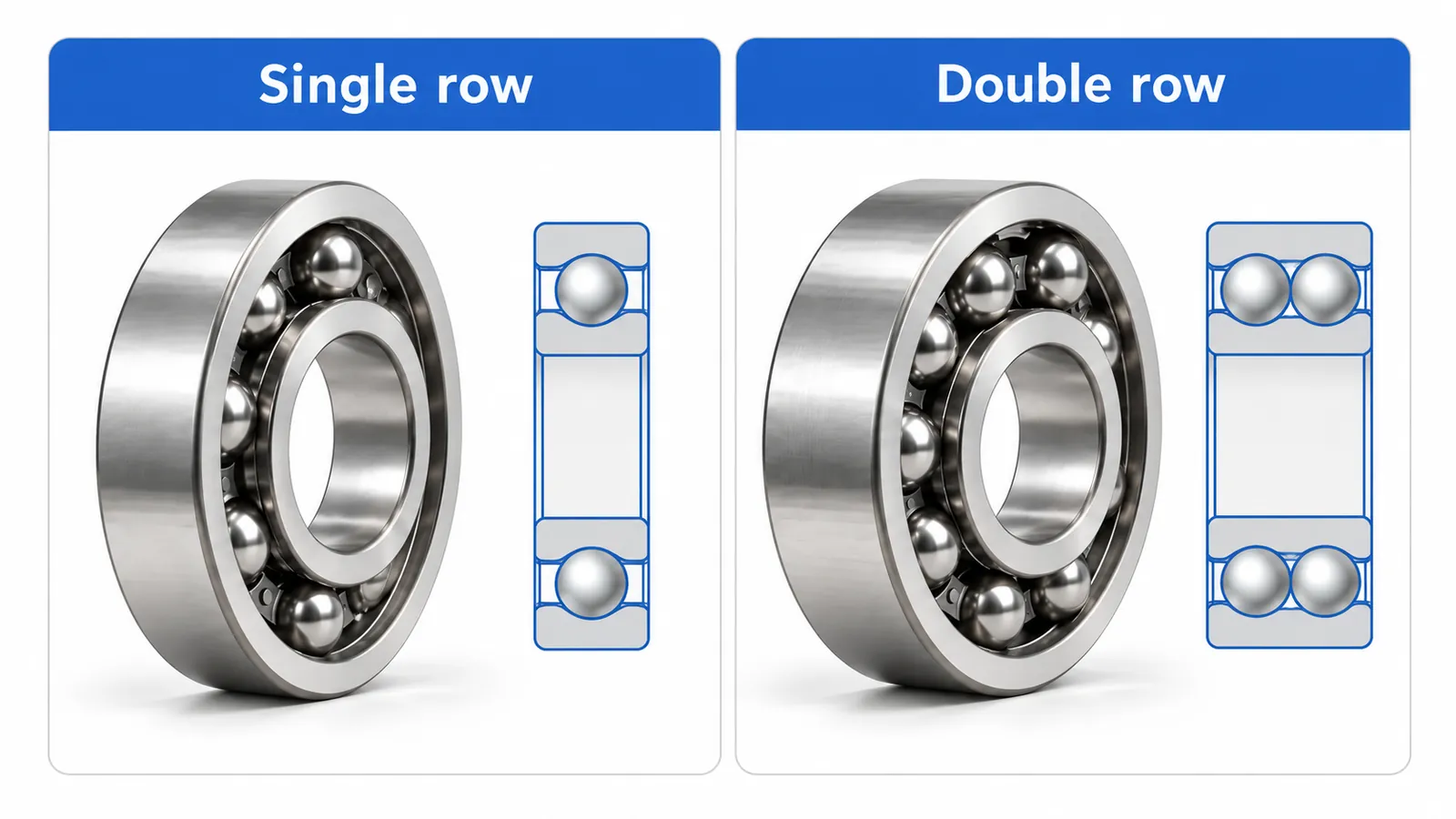
A double row deep groove ball bearing carries two rows of balls in one inner ring and one outer ring. The raceways are two deep grooves side by side, so the bearing behaves like two single row bearings mounted back to back in a single, narrower unit. It takes radial load and axial load in both directions, and it is stiffer than one single row bearing of the same bore because the load is shared over twice the number of balls.
The price of that capacity is width and speed. A double row bearing is wider than the single row bearing with the same bore and outside diameter, it runs at a lower limiting speed because it has more rolling contacts, and it tolerates less misalignment because both rows have to stay in line. In ISO 15 terms the double row deep groove series are 42 and 43; the single row series are 60, 62, 63 and 64, which is where the common motor and hub sizes such as 6205 sit.
| Feature | Single row (60, 62, 63, 64 series) | Double row (42, 43 series) |
|---|---|---|
| Rows of balls | 1 | 2 |
| Radial capacity, same bore and OD | Reference | Higher, roughly 1.3 times the single row value |
| Axial capacity | Both directions, moderate | Both directions, higher |
| Width | Narrow | Wider by 3 to 8 mm in the small sizes |
| Limiting speed | Higher | Lower |
| Misalignment tolerance | Low, a few minutes of arc | Lower |
| Shields and seals | Open, ZZ, 2RS, NR | Open, ZZ, 2RS |
| Typical designation | 6205, 6305 | 4205, 4305 |
Capacity ratio compares same-size ratings as published in manufacturer catalogs; it is indicative. Use the catalogue rating of the exact bearing you compare.
When should you choose a double row instead of a single row?
Choose a double row bearing when the shaft is short, the load is high and there is no room for a second bearing. Typical cases are the spindle of a small woodworking machine, a belt tensioner pulley, an agricultural gearbox input shaft, and a lightly loaded lifting drum where a single bearing at each end has to take a combined radial and axial load. The double row bearing gives you the capacity of a pair without the housing length of a pair.
Stay with a single row bearing when speed matters, when the shaft can deflect, or when the drawing already calls for a 60, 62 or 63 series size. Motors, pumps, motorcycle hubs and fans almost always use a single row deep groove ball bearing, because their loads are modest and the single row design runs cooler at speed. Most replacement enquiries that mention a double row bearing are really asking whether a double row part fits a housing that was designed around it, which is a size question, not a capacity question.
- High combined load on a short shaft, no space for two bearings: double row.
- Speed close to the limiting speed of the double row size: single row.
- Shaft that bends under load or is not aligned to the housing: single row, or a self-aligning type.
- Drawing quotes a 42 or 43 series number: double row, unless the housing has room for a pair.
Can a single row bearing replace a double row one in the same envelope?
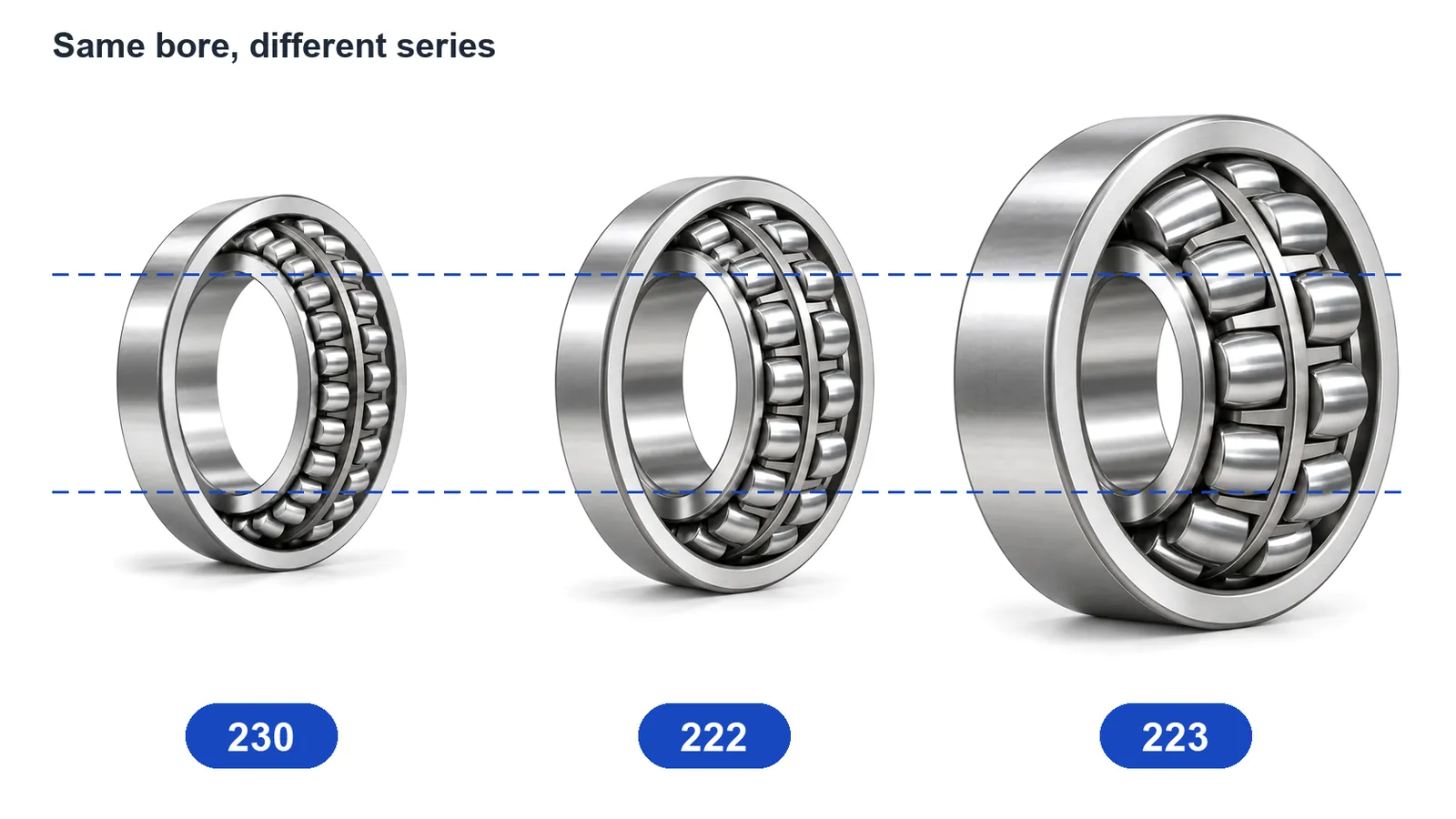
Bore and outside diameter match between a double row bearing and its single row counterpart, because both series follow the same ISO 15 diameter series. Only the width differs. That means a 4205 and a 6205 share the 25 mm bore and 52 mm outside diameter, but the 4205 is 18 mm wide and the 6205 is 15 mm wide. A single row bearing will physically fit the seat, but it will sit 3 mm short of the shoulder unless a spacer is added, and it will carry less load.
| Double row | d × D × B mm | Single row, same bore and OD | d × D × B mm | Width difference |
|---|---|---|---|---|
| 4204 | 20 × 47 × 18 | 6204 | 20 × 47 × 14 | 4 mm |
| 4205 | 25 × 52 × 18 | 6205 | 25 × 52 × 15 | 3 mm |
| 4206 | 30 × 62 × 20 | 6206 | 30 × 62 × 16 | 4 mm |
| 4305 | 25 × 62 × 24 | 6305 | 25 × 62 × 17 | 7 mm |
Double row widths are published ISO 15 values for the 42 and 43 series. Check the width on your drawing before ordering.
Two single row bearings side by side are the other route. Two 6205 bearings are 30 mm wide, so they need more shoulder length than one 4205, but they can be arranged face to face or back to back and they give you the choice of open, ZZ or 2RS versions on each side. If the housing is being redesigned, a pair of single row bearings is often the cheaper and more available option.
What do the ENRO single row sizes look like in the same bores?
ENRO lists single row deep groove ball bearings only. The table below shows the three single row series that share the 20, 25 and 30 mm bores used by the double row sizes above, with the catalogue ratings from the deep groove ball bearing range. The 60 series is the light section, the 62 series is the medium section and the 63 series is the heavy section; the heavier section has the larger outside diameter and the higher rating.
| Model | d × D × B mm | Cr kN | C0r kN |
|---|---|---|---|
| 6004 | 20 × 42 × 12 | 8.46 | 4.85 |
| 6204 | 20 × 47 × 14 | 11.52 | 6.65 |
| 6304 | 20 × 52 × 15 | 14.31 | 7.58 |
| 6005 | 25 × 47 × 12 | 9.09 | 5.62 |
| 6205 | 25 × 52 × 15 | 12.60 | 7.54 |
| 6305 | 25 × 62 × 17 | 19.08 | 10.46 |
| 6006 | 30 × 55 × 13 | 11.88 | 7.97 |
| 6206 | 30 × 62 × 16 | 17.55 | 10.85 |
| 6306 | 30 × 72 × 19 | 24.03 | 14.40 |
Cr is the basic dynamic load rating, C0r the basic static load rating. Both are catalogue reference values.
If the load that justified a double row bearing is mostly radial, moving one step up in section, for example from a 6205 to a 6305, usually recovers the capacity. The 6305 has the same 25 mm bore, a 62 mm outside diameter and a 17 mm width, so the housing bore changes but the shaft does not. Whether that is acceptable depends on the housing, which is why we ask for a drawing or a photo of the seat with every enquiry of this kind.
How do you order the right replacement?
Send the number on the old bearing, the bore, outside diameter and width you measured, and the shield or seal type you see on each face. If the number is a 42 or 43 series double row size, say so, and we will tell you which ENRO single row size shares the bore and outside diameter and by how much the width differs. If the number is a single row size, use the bearing cross reference to match it by boundary dimensions, or pick it directly from the size finder.
Every ENRO bearing is Made in China and passes 100% outgoing inspection under Japan-managed quality control. Load ratings, limiting speeds and weights are catalogue reference values and are confirmed per batch on request. We reply within 24 hours on business days.
Related ENRO products
Click a model to open its full specification page.