
Electric Motor Bearing Types
Electric Motor Bearing Types: the short answer
Most small and medium electric motors run on deep groove ball bearings, usually one at each end of the shaft. Larger motors with belt or heavy radial loads often use a cylindrical roller bearing at the drive end. C3 internal clearance is common in motors because the shaft runs warmer than the housing. The choice within the deep groove type is then closure (open, ZZ or 2RS) and clearance group (CN, C3 or C4), and the size usually follows the IEC frame.
Key takeaways
- Deep groove ball bearings are the standard choice for small and medium motors, at both ends of the shaft.
- C3 clearance is common in motors; C4 is used where the temperature difference is larger.
- ZZ shields suit clean, fast motors; 2RS seals suit dusty or damp sites.
- Cylindrical roller, angular contact and insulated bearings appear only in large, vertical or inverter-driven motors.
Which bearing types are used in electric motors?
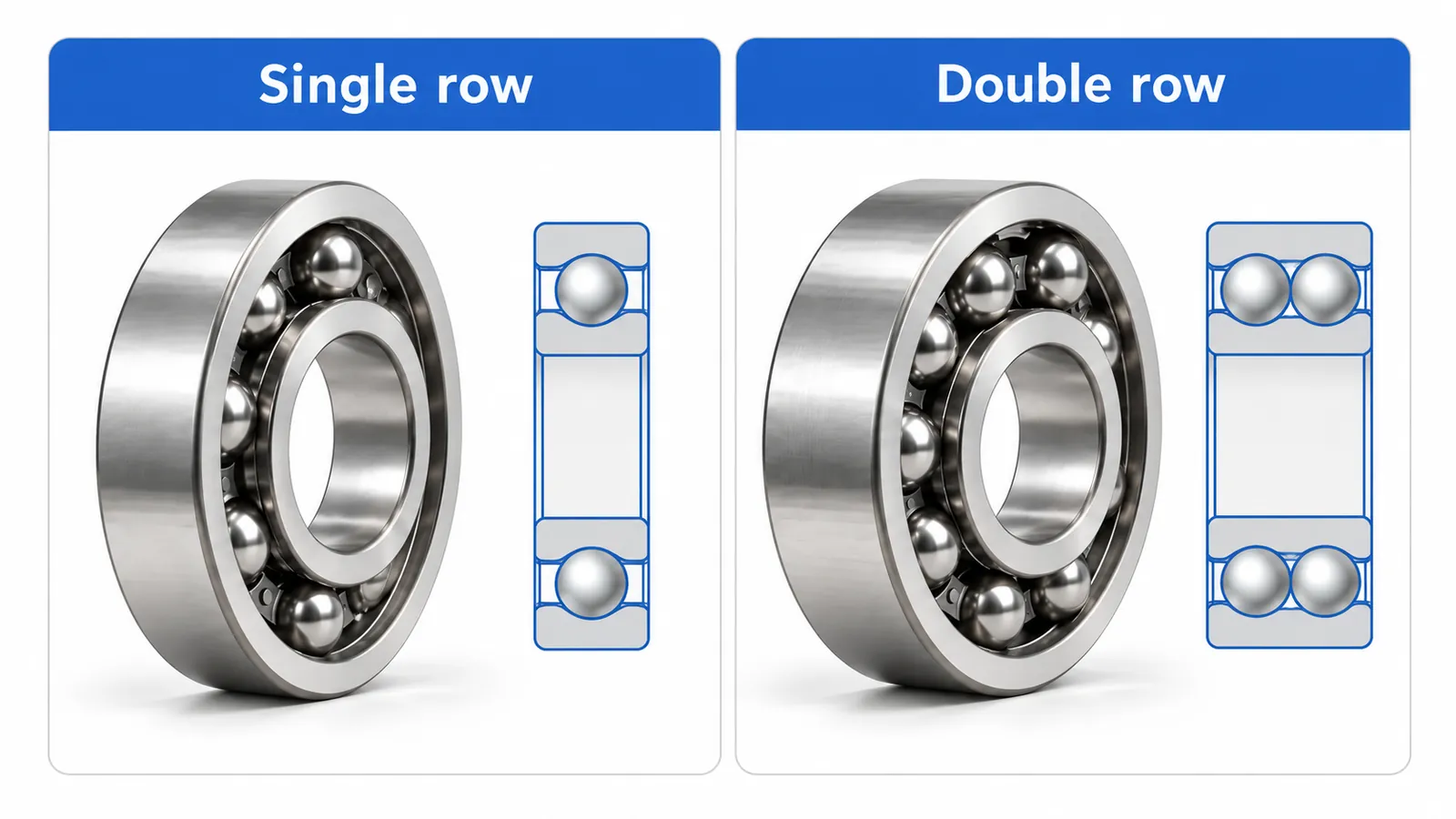
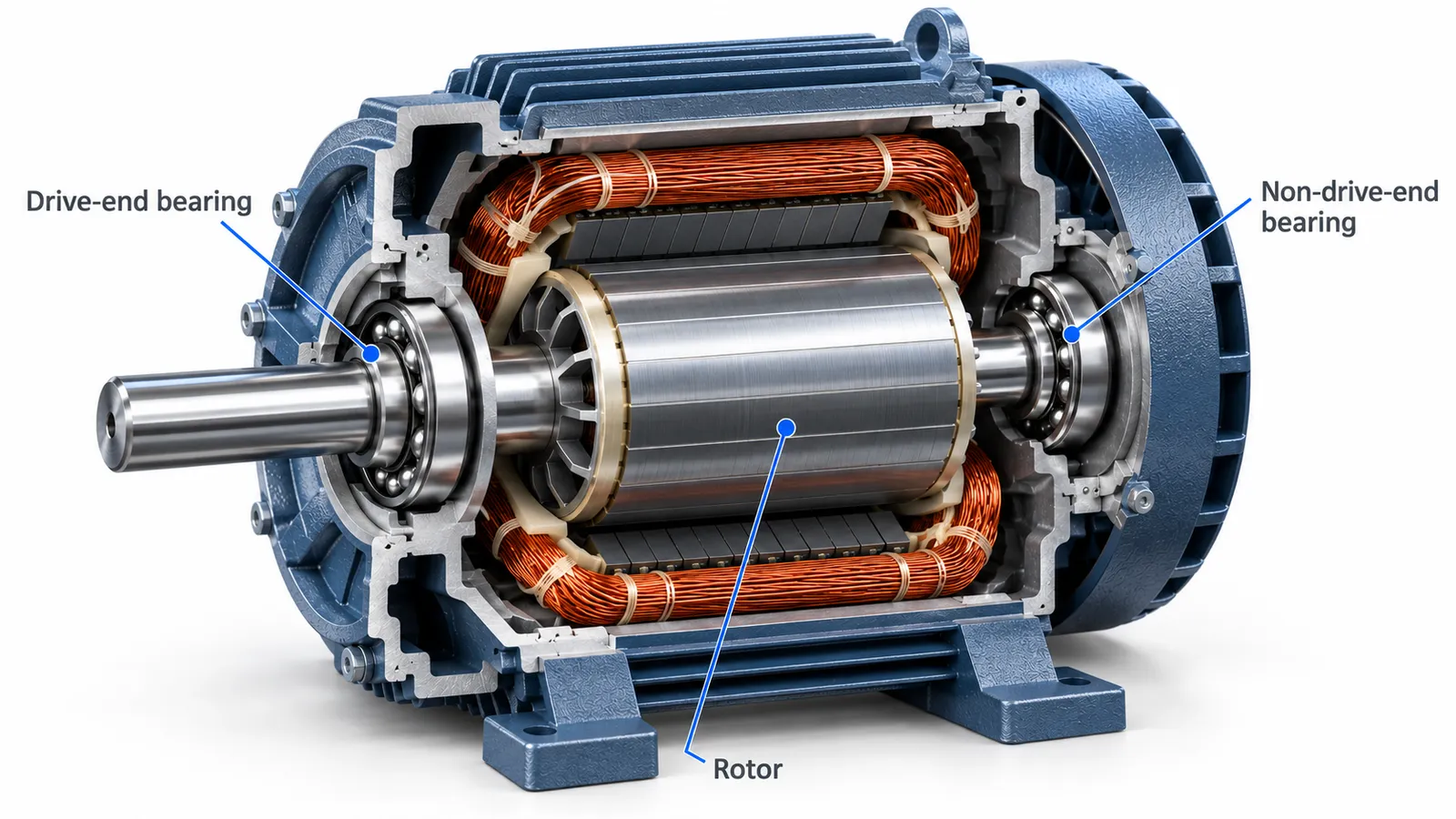
An electric motor needs two bearings that hold the rotor concentric in the stator, carry the rotor weight and whatever the coupling or belt adds, and locate the shaft axially. In small and medium motors both of those bearings are single row deep groove ball bearings. Larger frames and heavy belt drives change the drive end, and a few special cases change the type altogether.
| Bearing type | Where it is used in motors | Why |
|---|---|---|
| Deep groove ball bearing | Both ends of small and medium frames, non-drive end of most larger frames | Radial plus axial load, high speed, low friction, cheap, available sealed |
| Cylindrical roller bearing (NU, N) | Drive end of large frames with belt or gear drive | High radial capacity, free axial movement for thermal growth |
| Angular contact ball bearing | Vertical motors, pump motors with thrust | Carries thrust in one direction; used in pairs |
| Insulated or hybrid bearing | Non-drive end of inverter-driven motors | Blocks shaft current that erodes steel raceways |
| Spherical roller bearing | Very large, slow motors and generators | Heavy load, tolerates misalignment |
| Sleeve (plain) bearing | Large slow motors, some fractional horsepower motors | Quiet, long life at constant speed with oil supply |
Why are deep groove ball bearings the default for motors?
The rotor of a standard motor is light for its size, it turns fast, and it is coupled with modest axial forces. A deep groove ball bearing carries that combination with the lowest friction of any rolling bearing, which keeps the bearing cool and the motor efficient. It is available with shields or seals, so the motor maker can fill it with grease for life and forget it. It is made in enormous quantities, so it is cheap and easy to replace anywhere.
Two deep groove ball bearings on one shaft also solve the location problem simply. One bearing, usually the drive end, is fixed in its housing and locates the shaft. The other floats in its housing bore by a few tenths of a millimetre, often with a wave spring behind it, so that the shaft can grow with temperature and the bearings stay lightly preloaded. That spring is why the non-drive end bearing on a motor is often the quieter one. The ENRO deep groove ball bearing range covers the 60, 62, 63 and 64 series sizes that these frames use.
Which shield or seal should a motor bearing have?
The suffix after the number tells you how the bearing is closed. Motors that run clean and fast use shields; motors that see dust, water or washdown use seals. Open bearings are used where the motor housing itself is sealed and the bearing is regreased through a nipple.
| Version | Closure | Friction and speed | Choose it for |
|---|---|---|---|
| Open | None | Lowest friction, full speed | Regreasable housings, large frames with grease nipples |
| ZZ | Steel shield each side, non-contact | Very low friction, full speed | Clean environments, small motors, fans, hand tools |
| 2RS | Rubber contact seal each side | Higher friction, reduced speed | Dust, moisture, outdoor and agricultural motors |
| NR | Snap ring groove on outer ring | As open | Housings that locate the bearing with a circlip |
If the original bearing was ZZ and the motor is now in a dustier place, 2RS is a sensible change; the small extra friction is rarely noticeable below the speed limit for sealed bearings. The sealed bearing page lists which ENRO sizes are available with 2RS seals.
Which clearance group do motors need?
Motor makers usually specify C3 clearance. The inner ring is pressed onto the shaft with an interference fit, which reduces the internal clearance, and the shaft runs warmer than the housing, which reduces it again. C3 leaves enough clearance after both effects that the balls are not preloaded. Small motors with light fits can use CN; large frames, high temperature or heavy interference fits move to C4.
| Group | When motors use it |
|---|---|
| CN | Fractional horsepower motors with slip or light push fits |
| C3 | Standard industrial motors, frame 63 to 315, the common specification |
| C4 | High temperature, high inner ring interference, large frames, traction motors |
What sizes do IEC frame motors usually use?
IEC frame numbers describe the shaft centre height in millimetres, and motor makers tend to fit similar bearings to similar frames. The table gives the sizes most often found at the drive end (DE) and non-drive end (NDE) of standard foot-mounted motors. Individual makers differ, especially at the drive end of belt-driven frames, so treat it as a starting point and confirm from the nameplate or the motor manual. The electric motor bearing page groups the ENRO sizes with a motor application in one filterable table.
| IEC frame | Drive end (typical) | Non-drive end (typical) |
|---|---|---|
| 63 | 6201 | 6201 |
| 71 | 6202 | 6202 |
| 80 | 6204 | 6204 |
| 90 | 6205 | 6205 |
| 100 | 6206 | 6206 |
| 112 | 6206 | 6206 |
| 132 | 6208 | 6208 |
| 160 | 6309 | 6209 |
| 180 | 6310 | 6210 |
| 200 | 6312 | Varies by maker |
| 225 | 6313 | 6213 |
Cross-checked against published motor maker catalogs. Linked models are in the ENRO range. Sizes vary by maker and by 2, 4 or 6 pole design; above frame 225 the pairing depends so much on maker and pole count that no typical size is given, and 4-pole or belt-driven motors often use a cylindrical roller bearing at the drive end. Check before ordering.
| Model | d × D × B mm | Cr kN | C0r kN |
|---|---|---|---|
| 6205 | 25 × 52 × 15 | 12.60 | 7.54 |
| 6206 | 30 × 62 × 16 | 17.55 | 10.85 |
| 6207 | 35 × 72 × 17 | 23.13 | 14.69 |
| 6208 | 40 × 80 × 18 | 26.19 | 17.09 |
How do you specify a motor bearing when ordering?
Give the full designation as it appears on the old bearing: base number, closure suffix and clearance suffix, for example 6205 2RS C3. If the number is worn off, measure the bore, outside diameter and width and use the size finder or send the measurements. Add the quantity and the destination country and we quote from the ENRO range. Every ENRO bearing is Made in China and passes 100% outgoing inspection under Japan-managed quality control. We reply within 24 hours on business days.
- Base number: sets bore, outside diameter and width.
- Closure: open, ZZ or 2RS, one letter set per bearing.
- Clearance: CN if no suffix, C3 for most motors.
- Quantity per line and whether you need the two ends as a matched set.
Related ENRO products
Click a model to open its full specification page.