
Electric Motor Bearing Failure
Electric Motor Bearing Failure: the short answer
Lubrication problems, contamination, misalignment, wrong fits, overload, and electrical erosion from shaft currents in inverter-driven motors. Read the wear path on the old bearing before you order: it tells you whether the replacement needs a different seal, a different clearance group, or a fix to the motor rather than the bearing.
Key takeaways
- Check lubrication and contamination first; they account for many early failures.
- Match the replacement to the original shield or seal type and clearance group.
- Inverter-driven motors can suffer electrical erosion of the raceways; fix it at the drive or with an insulated bearing, not with a standard steel bearing.
- Fatigue flaking after long service is the only failure the bearing is rated for; everything else is a mounting, lubrication or environment problem.
What are the most common causes of electric motor bearing failure?
Most motor bearings do not wear out. They are killed early by something that could have been seen at installation or at the first service. Lubrication problems, dirt and water, wrong fits, and misalignment between motor and driven machine account for the majority of returns. Genuine rolling contact fatigue, the failure a bearing is rated for, is the exception rather than the rule in small and medium motors.
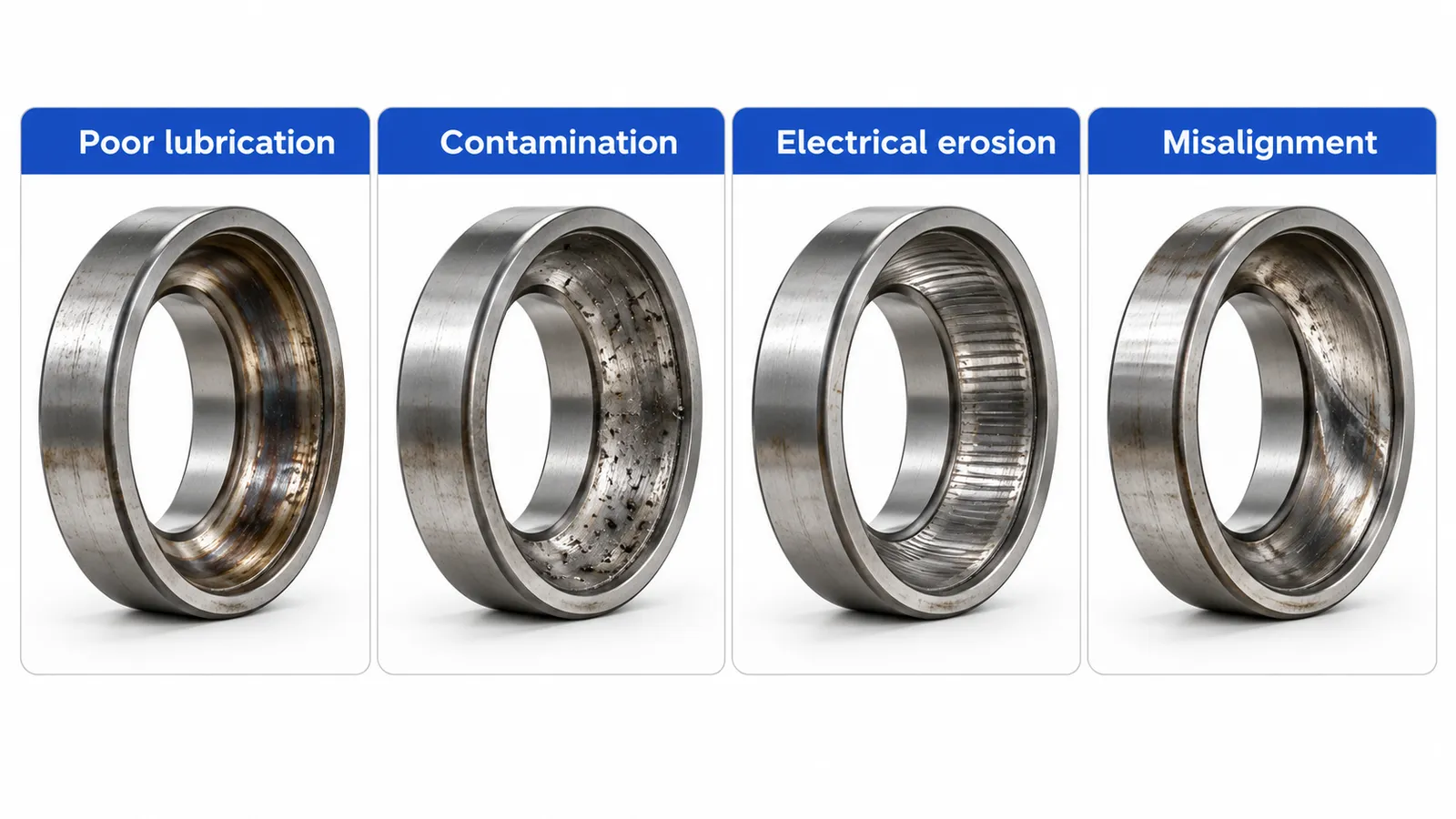
| Cause | What you see on the bearing | Usual root cause | What fixes it |
|---|---|---|---|
| Poor lubrication | Discoloured races, smeared or glazed surfaces, dry cage | Wrong grease, too little or too much grease, no regreasing interval | Correct grease fill, ZZ or 2RS version for life lubrication in small sizes |
| Contamination | Dents in the raceways, dull scratched surfaces, grey grease | Open bearing in a dusty site, damaged seals, dirty assembly | 2RS seals, clean assembly, keep the box closed until fitting |
| Wrong fit | Fretting rust on bore or outside surface, ring turning on the seat | Worn shaft or housing seat, wrong tolerance class | Recut or sleeve the seat, use the fit the motor maker specifies |
| Misalignment | Wear path runs at an angle across the raceway | Coupling or belt not aligned, bent shaft, end shield not seated | Align coupling, check pulley offset, seat end shields squarely |
| Overload or false brinelling | Regularly spaced marks at ball pitch | Belt tension too high, vibration while standing still, hammer fitting | Correct belt tension, isolate standing motors from vibration, press fit only |
| Electrical erosion | Washboard fluting, grey frosted raceways | Shaft voltage on inverter drives, welding current through the motor | Grounding brush or insulated bearing at one end, bond welding return correctly |
| Overheating | Blue or brown rings, hardened grease, reduced clearance | Blocked cooling, high ambient, clearance too small for the fit | Restore cooling, choose C3 clearance where the shaft runs warm |
| Fatigue | Flaking (spalling) of the raceway after long service | Bearing reached its rating life | Replace with the same size; consider the next section up if load has grown |
How do you read the damage pattern on a failed motor bearing?
Cut the old bearing open before you throw it away, or at least look at the raceways under a light. The wear path tells you what happened. A narrow path that runs centrally around the outer ring with a wider, uniform path on the inner ring is normal for a radial load with the inner ring rotating. Anything else is a clue.
| Pattern on the raceway | What it means | Check |
|---|---|---|
| Path offset to one side, same width all round | Axial load in one direction | Coupling gap, pulley position, magnetic centre |
| Path that wanders from side to side | Misalignment or bent shaft | Shaft run-out, end shield fit |
| Path wider on one half of the outer ring | Outer ring out of round, housing distorted | Housing roundness, bolt torque sequence |
| Equally spaced dents at ball pitch | Static overload or vibration at standstill | Fitting method, transport, standby vibration |
| Fine parallel lines across the raceway (fluting) | Electrical current through the bearing | Inverter drive, grounding |
| Isolated flaked areas | Fatigue, or debris denting that later flaked | Load, contamination |
| Rust on the raceways, not the seat | Water entry or condensation | Seal type, storage, washdown |
Photograph the inner ring, outer ring and cage separately and keep the grease sample. If you send those photographs with your enquiry we can suggest whether a different shield or seal version, or a different clearance group, would have changed the outcome.
Why do inverter-driven motors suffer electrical erosion?
A variable frequency drive switches the motor voltage tens of thousands of times a second. The fast edges couple a common mode voltage onto the shaft through the stray capacitance of the windings. When the voltage across the thin oil film in the bearing exceeds what the film can hold, it discharges through the film. Each discharge melts a microscopic pit in the raceway. Over weeks the pits line up into the washboard pattern called fluting, the bearing gets noisy, and it fails long before its rated life.
The cure is to give the current an easier path or to block it. A shaft grounding brush or ring diverts the current to the frame. An insulated bearing at the non-drive end, or a ceramic ball hybrid bearing, breaks the circuit. Standard steel deep groove ball bearings, including the ENRO range, are not insulated, so on inverter-driven motors above a few kilowatts specify the drive-side mitigation at the motor, not at the bearing.
How do clearance and fit relate to early failure?
The clearance group printed on the box is the clearance before mounting. Pressing the inner ring onto the shaft expands it and takes some of that clearance away; a warm shaft expands it further. If the bearing ends up with negative operating clearance, the balls are preloaded, the bearing runs hot, and it fails by overheating rather than by fatigue. That is why motor makers so often specify C3.
| Clearance group | Relative clearance | Typical motor use |
|---|---|---|
| CN (normal) | Reference | Small motors with light fits and small temperature difference between rings |
| C3 | Larger than CN | Most industrial motors: tight inner ring fit, shaft runs warmer than housing |
| C4 | Larger than C3 | Motors with high temperature difference, large frames, or heavy interference fits |
| C2 | Smaller than CN | Precision spindles; rarely used in standard motors |
Match the group on the replacement to the group on the original, or to the motor manual. Do not "upgrade" to C4 because it sounds safer: too much clearance makes the bearing noisy and lets the balls skid under light load. If the original number ends in C3, order C3. The electric motor bearing page lists the sizes ENRO offers; the clearance group available for a given model and quantity is confirmed on the quotation.
Which ENRO sizes are typical replacements in small and medium motors?
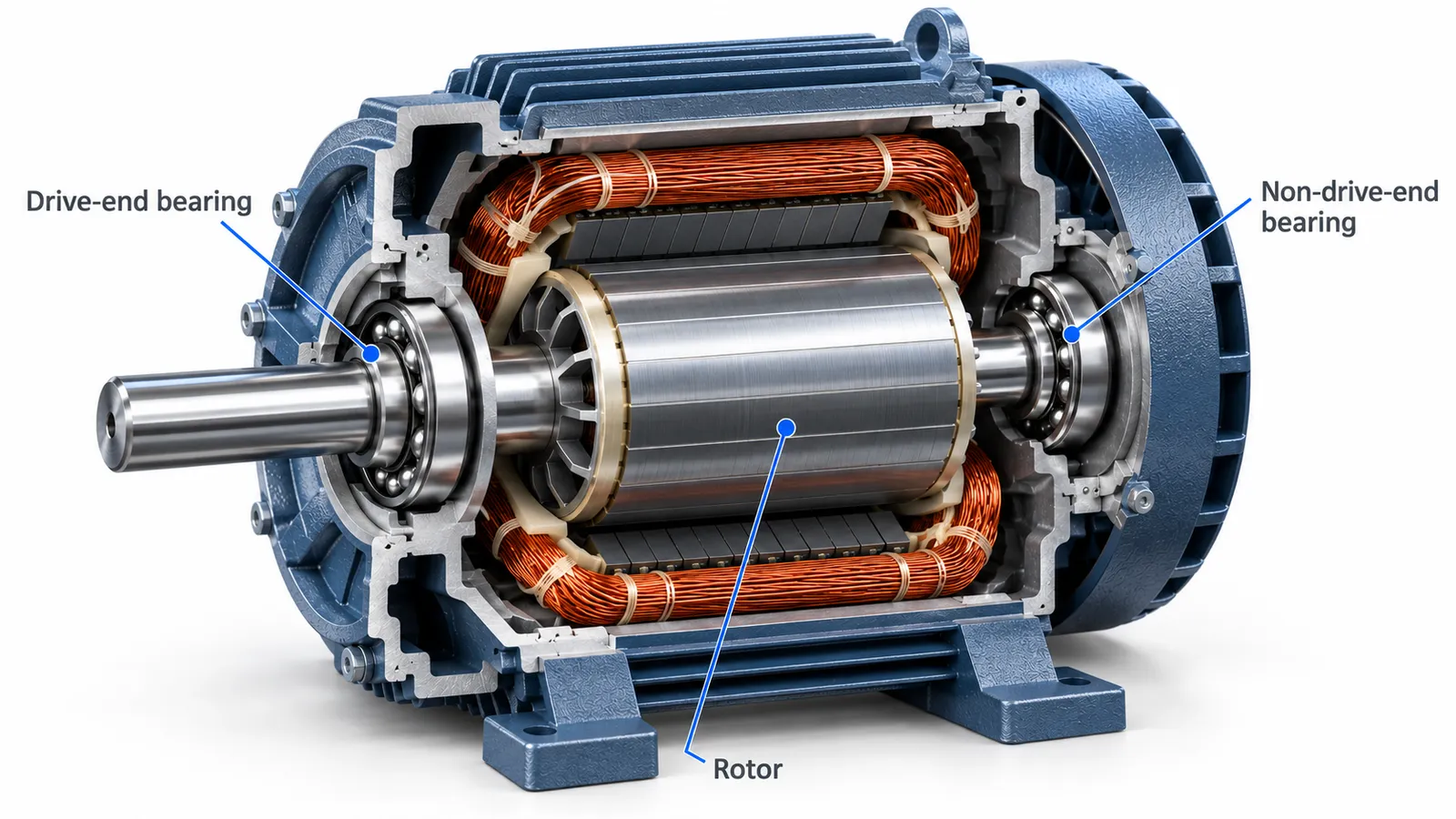
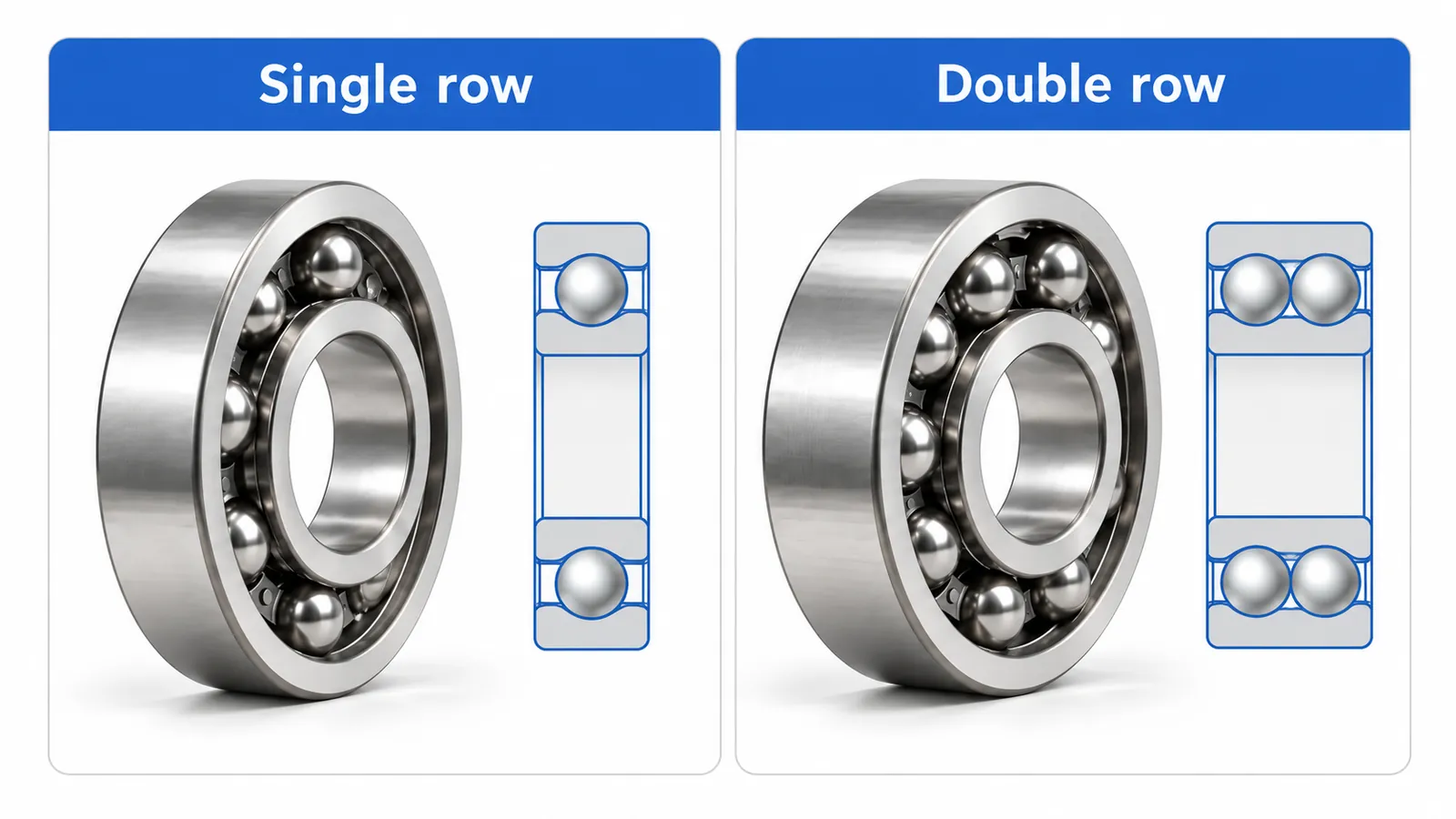
The sizes below are the deep groove ball bearings that ENRO lists with a typical motor or generator application. Ratings are catalogue reference values. All four are single row and are available open, with ZZ shields or with 2RS seals; the full list is on the deep groove ball bearing page.
| Model | d × D × B mm | Cr kN | Grease speed rpm | Typical application |
|---|---|---|---|---|
| 6205 | 25 × 52 × 15 | 12.60 | 12000 | Motorcycle hubs, electric motors, pumps |
| 6206 | 30 × 62 × 16 | 17.55 | 10000 | Electric motors, water pumps |
| 6207 | 35 × 72 × 17 | 23.13 | 9300 | Motors, generators |
| 6208 | 40 × 80 × 18 | 26.19 | 8300 | Motors, industrial machinery |
| 6308 | 40 × 90 × 23 | 36.45 | 7400 | Industrial motors, conveyors |
What should you send when you order a replacement?
A photograph of the old bearing face with the number visible, the measured bore, outside diameter and width, the shield or seal type, the clearance suffix if any, and the motor nameplate. With that we match the size, tell you which versions ENRO has, and quote. Every ENRO bearing is Made in China and passes 100% outgoing inspection under Japan-managed quality control. We reply within 24 hours on business days.
- Bearing number and any suffix (ZZ, 2RS, C3).
- Measured d, D and B if the number is not readable.
- Motor frame size, speed and whether it is inverter driven.
- Quantity per size and destination country for the quotation.
Related ENRO products
Click a model to open its full specification page.