
Spherical Roller Bearing Size Chart
Sizes in this guide
Spherical Roller Bearing Size Chart: the short answer
Spherical roller bearing sizes follow the ISO 15 dimension series: the last two digits of the number fix the bore and the first three fix the series, which sets outside diameter and width. ENRO lists 231 sizes in series 22200, 21300, 22300, 24000, 23200, 23100, 24100, 23000, 23900, 23800, 24800, from 25–500 mm bore and 52–920 mm outside diameter, each with cylindrical or tapered bore and the W33 groove.
Key takeaways
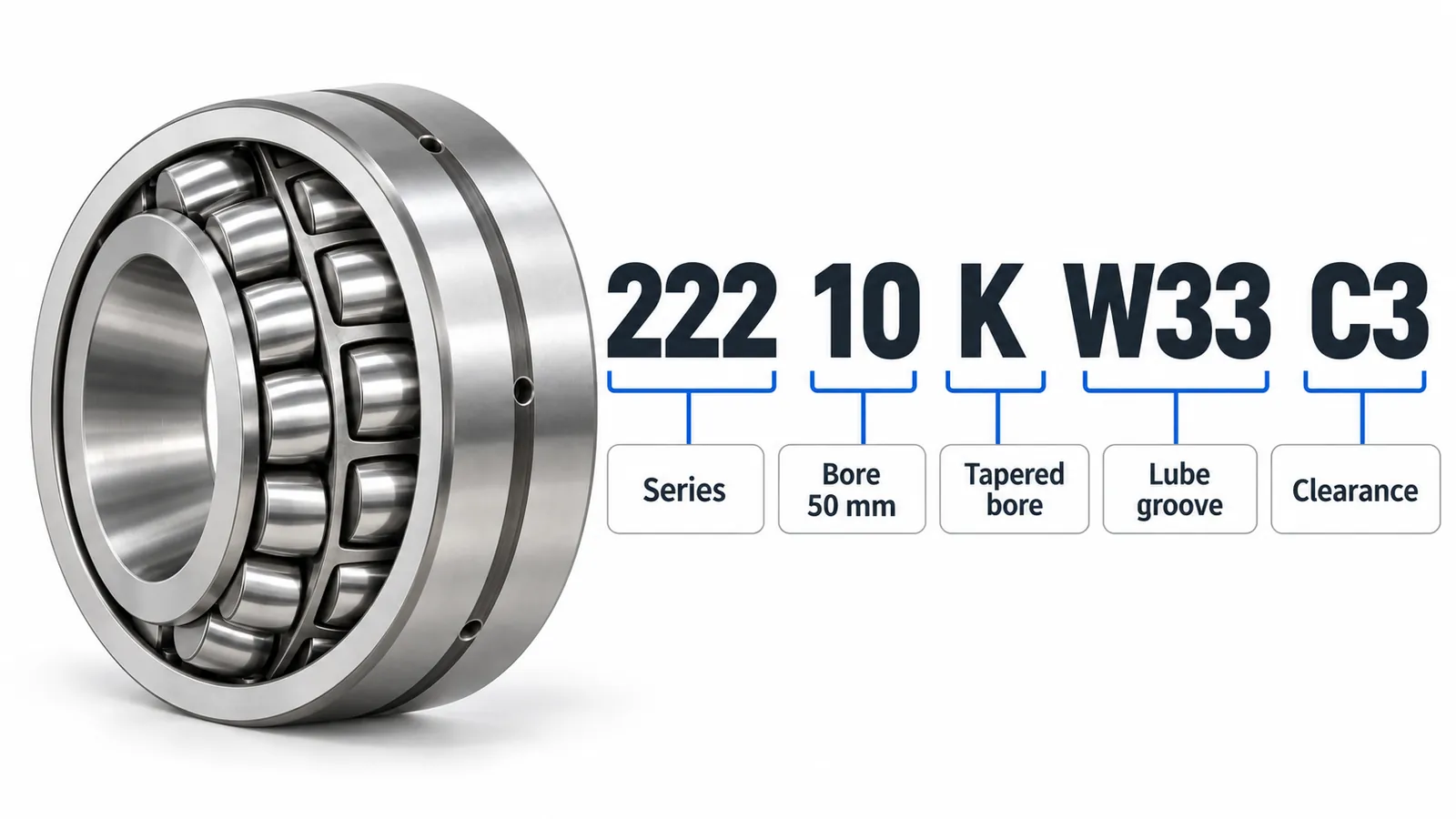
- The first three digits give the dimension series (for example 222) and the last two the bore code × 5. 22210 is a 222-series bearing with a 50 mm bore. For bores of 500 mm and up the bore is written after a slash, such as 230/500.
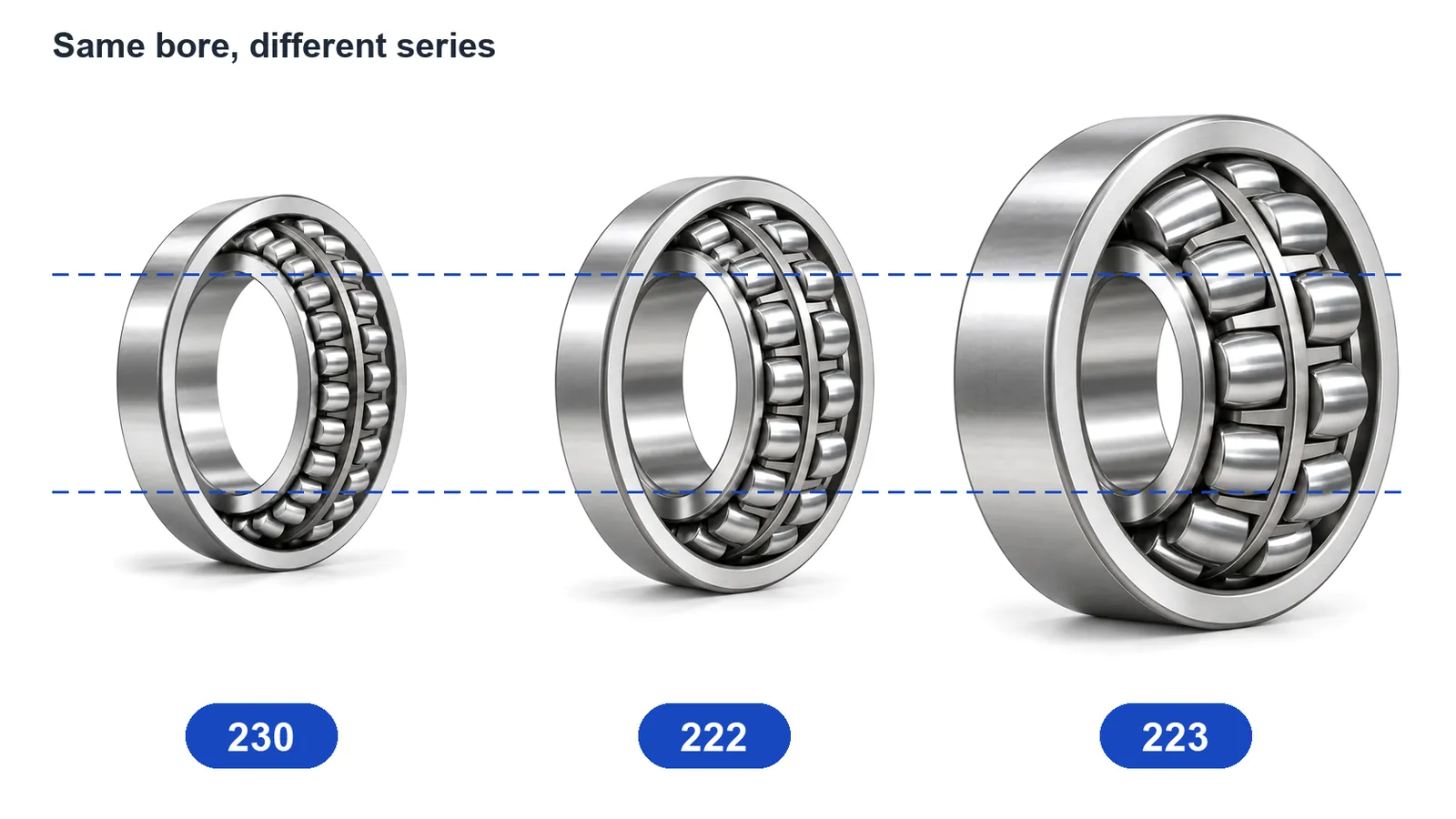
- Series with the same bore code share the bore; D and B grow from 239 (thin) to 223 (heavy).
- Compare Cr for rotating duty and C0r for stationary, oscillating or shock-loaded duty.
- The full per-model table with ratings is on the spherical roller bearing page.
How is a spherical roller bearing size chart organised?
Every spherical roller bearing size chart is really a grid of two things: the bore, which is fixed by the last two digits of the number, and the series, which is fixed by the first three digits and sets how much outside diameter and width you get for that bore. Once you can read both, any chart from any maker becomes the same chart, because the boundary dimensions are defined by ISO 15 and not by the maker.
The series code is built from the ISO 15 dimension series. The second digit is the width series and the third is the diameter series; a higher diameter series means a larger outside diameter and a higher load rating for the same bore. The table shows the eleven series that appear in most charts and what section they give you.
| Series | ISO 15 dimension series | Width and diameter series | Section |
|---|---|---|---|
| 239 | 39 | Width 3, diameter 9 | Thinnest section; large bore, small load |
| 230 | 30 | Width 3, diameter 0 | Light section |
| 240 | 40 | Width 4, diameter 0 | Light section, wider |
| 231 | 31 | Width 3, diameter 1 | Medium-light section |
| 241 | 41 | Width 4, diameter 1 | Medium-light section, wider |
| 222 | 22 | Width 2, diameter 2 | Medium section; the most common series |
| 232 | 32 | Width 3, diameter 2 | Medium section, wider |
| 213 | 03 | Width 0, diameter 3 | Heavy section, narrow |
| 223 | 23 | Width 2, diameter 3 | Heavy section, wide; highest capacity per bore |
| 238 | 38 | Width 3, diameter 8 | Very thin section, large bore |
| 248 | 48 | Width 4, diameter 8 | Very thin section, wider |
Which series does the ENRO chart cover?
ENRO lists 231 spherical roller bearing sizes. The ranges below are taken from the current list; each series link opens the full per-size table with ratings, and the spherical roller bearing page shows all sizes on one screen. Every size is offered with a cylindrical bore and with a tapered bore (K, or K30 for the 240 and 241 series), and all sizes have the W33 lubrication groove.
| Series | Bore d mm | Outside D mm | Width B mm | Sizes listed |
|---|---|---|---|---|
| 22200 | 25–360 | 52–650 | 18–170 | 33 |
| 21300 | 25–100 | 62–215 | 17–47 | 16 |
| 22300 | 40–400 | 90–820 | 33–243 | 28 |
| 24000 | 65–500 | 100–720 | 35–218 | 28 |
| 23200 | 90–500 | 160–920 | 52.4–336 | 27 |
| 23100 | 100–500 | 165–830 | 52–264 | 26 |
| 24100 | 100–500 | 165–830 | 65–325 | 26 |
| 23000 | 110–500 | 170–720 | 45–167 | 25 |
| 23900 | 180–500 | 250–670 | 52–128 | 18 |
| 23800 | 300–500 | 380–620 | 60–90 | 3 |
| 24800 | 460–460 | 580–580 | 118–118 | 1 |
Series pages list every size with d, D, B and catalogue ratings.
How do you read the bore from the number?
The bore code is the last two digits. For codes 04 and above, multiply by five. The four smallest codes are fixed values that do not follow the rule, and above 480 mm the bore is written out after a slash. This rule is the same for deep groove ball bearings, so a 6210 and a 22210 both have a 50 mm bore.
| Bore code | Bore d mm | Rule |
|---|---|---|
| 00 | 10 | Fixed values for the four smallest codes |
| 01 | 12 | Fixed |
| 02 | 15 | Fixed |
| 03 | 17 | Fixed |
| 04 to 96 | 20 to 480 | Code × 5, for example 10 → 50 mm, 40 → 200 mm |
| /500 and above | As written | Bore written in millimetres after a slash, for example 230/500 |
So 22210 is series 222, bore code 10, bore 50 mm; 23140 is series 231, bore code 40, bore 200 mm; and 230/500 is series 230 with a 500 mm bore. The bearing number guide works through more examples, including the K and W33 suffixes.
What does the same bore look like across series?
Reading down one bore across several series is the fastest way to see what the series code buys you. For a 100 mm bore the chart below runs from the lightest section ENRO lists to the heaviest. Outside diameter and width both grow, and the dynamic rating Cr grows with them, because the heavier series has longer, larger rollers.
| Model | Series | d × D × B mm | Cr kN | C0r kN |
|---|---|---|---|---|
| 24020 | 24000 | 100 × 150 × 50 | 285 | 415 |
| 23120 | 23100 | 100 × 165 × 52 | 365 | 490 |
| 24120 | 24100 | 100 × 165 × 65 | 455 | 640 |
| 22220 | 22200 | 100 × 180 × 46 | 428 | 490 |
| 23220 | 23200 | 100 × 180 × 60.3 | 475 | 600 |
| 21320 | 21300 | 100 × 215 × 47 | 425 | 490 |
| 22320 | 22300 | 100 × 215 × 73 | 815 | 950 |
A 50 mm bore gives the same picture in a smaller frame. The 213 series is narrow with a large outside diameter; the 223 series uses the same outside diameter but is much wider, and its rating is correspondingly higher.
| Model | Series | d × D × B mm | Cr kN | C0r kN |
|---|---|---|---|---|
| 22210 | 22200 | 50 × 90 × 23 | 104 | 108 |
| 21310 | 21300 | 50 × 110 × 27 | 156 | 166 |
| 22310 | 22300 | 50 × 110 × 40 | 220 | 224 |
Which rating should you compare: Cr or C0r?
Cr, the basic dynamic load rating, is the constant radial load that gives a basic rating life of one million revolutions. Use it when the bearing rotates and you want to estimate life; the L10 formula for roller bearings is L10 = (Cr/P)^(10/3) million revolutions, where P is the equivalent dynamic load. C0r, the basic static load rating, is the load that produces a fixed amount of permanent deformation at the most heavily loaded roller contact. Use it when the bearing is stationary, oscillates slowly, or sees shock loads.
Spherical roller bearings are chosen for heavy, slow, misaligned duty, so C0r matters more often than it does for ball bearings. Two sizes with a similar Cr can have quite different C0r, as the 22312 and 23120 rows below show. The bearing life calculator applies the ISO 281 formula to the ENRO ratings for you.
| Model | d × D × B mm | Cr kN | C0r kN |
|---|---|---|---|
| 22210 | 50 × 90 × 23 | 104 | 108 |
| 22216 | 80 × 140 × 33 | 238 | 270 |
| 22220 | 100 × 180 × 46 | 428 | 490 |
| 22312 | 60 × 130 × 46 | 310 | 335 |
| 23120 | 100 × 165 × 52 | 365 | 490 |
| 23140 | 200 × 340 × 112 | 1600 | 2360 |
How do you use the chart to order?
Measure or read the bore, outside diameter and width, find the row whose three dimensions match, and note the full designation including the bore type and the W33 groove. If your drawing gives a number from another catalogue, use the bearing cross reference: boundary dimensions are the same for every maker, so the ENRO size with the same three dimensions is dimensionally interchangeable. Every ENRO bearing is Made in China and passes 100% outgoing inspection under Japan-managed quality control. Ratings are catalogue reference values, confirmed per batch on request.
- Bore: last two digits, times five above code 03.
- Series: first three digits, sets outside diameter and width.
- Suffix: K or K30 for a tapered bore, W33 for the lubrication groove, C3 or C4 for clearance.
- Send the designation and quantity, or use the size finder if you only have measurements.
Related ENRO products
Click a model to open its full specification page.