
Spherical Roller Bearing Number
Sizes in this guide
Spherical Roller Bearing Number: the short answer
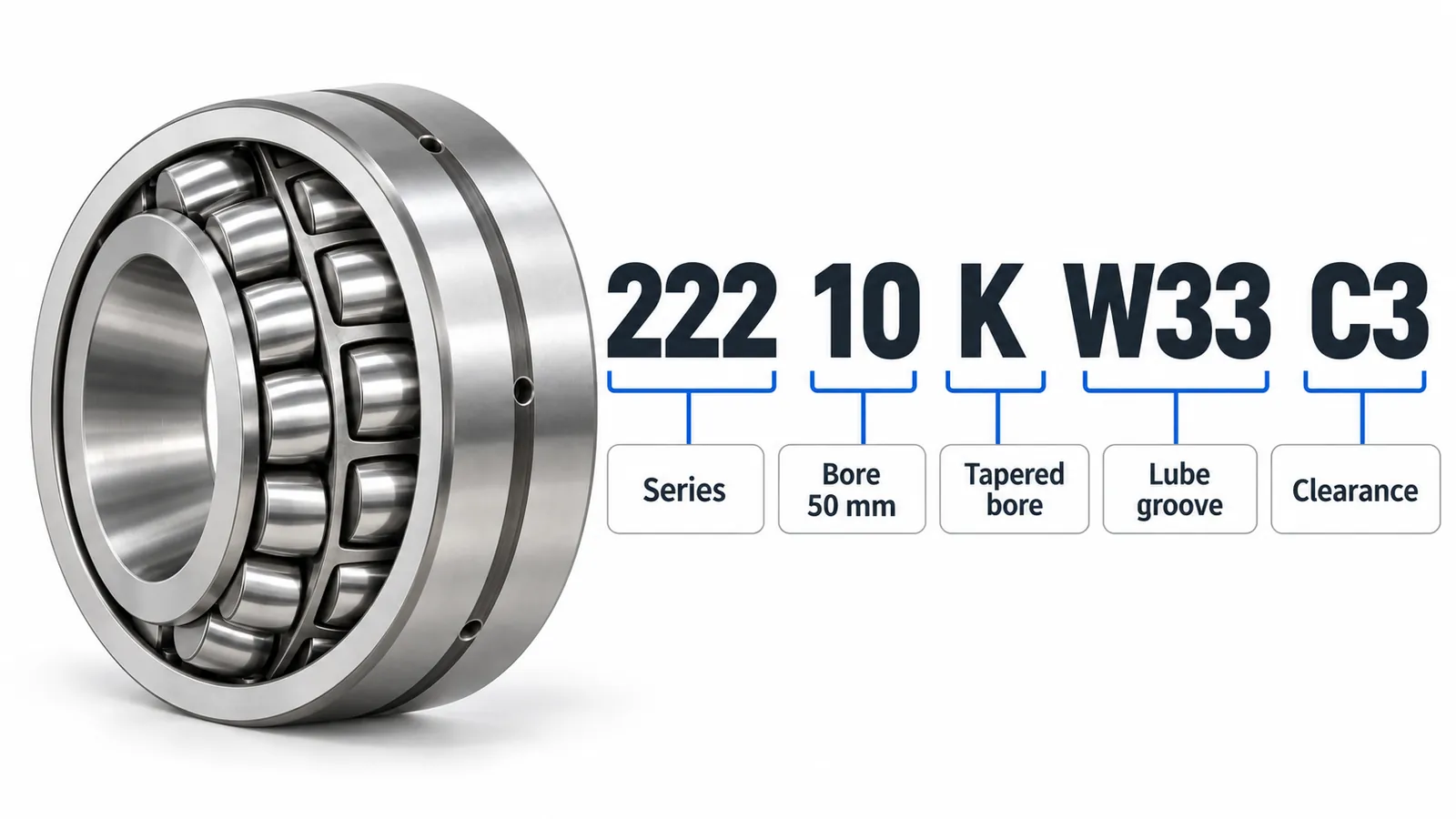
The first three digits give the dimension series (for example 222) and the last two the bore code × 5. 22210 is a 222-series bearing with a 50 mm bore. For bores of 500 mm and up the bore is written after a slash, such as 230/500. A 22210 K W33 C3 is therefore a spherical roller bearing (2) in width series 2 and diameter series 2, with a 50 mm bore, a 1:12 tapered bore, a lubrication groove, and C3 clearance.
Key takeaways
- Three-digit series code, then the bore code.
- K means a 1:12 tapered bore; K30 a 1:30 taper; W33 a lubrication groove with holes.
- For 500 mm bore and above the bore is written after a slash.
- Cage and internal design letters from other catalogues do not change the boundary dimensions.
How is a spherical roller bearing number built?
A spherical roller bearing number such as 22210 K W33 C3 is five digits plus suffixes, and every part of it has a fixed meaning. The first digit is the bearing type: 2 is a spherical roller bearing. The second digit is the ISO 15 width series and the third is the diameter series; together with the type they form the three-digit series code. The last two digits are the bore code. Anything after the digits is a suffix describing the bore shape, lubrication features, cage or clearance.
| Position | Example 22210 | Meaning |
|---|---|---|
| Digit 1 | 2 | Bearing type: spherical roller bearing |
| Digit 2 | 2 | Width series (ISO 15) |
| Digit 3 | 2 | Diameter series (ISO 15) |
| Digits 4–5 | 10 | Bore code: 10 × 5 = 50 mm |
| Suffix | K | Tapered bore, 1:12 |
| Suffix | W33 | Lubrication groove and holes in the outer ring |
| Suffix | C3 | Radial clearance group larger than normal |
What do the series codes mean?
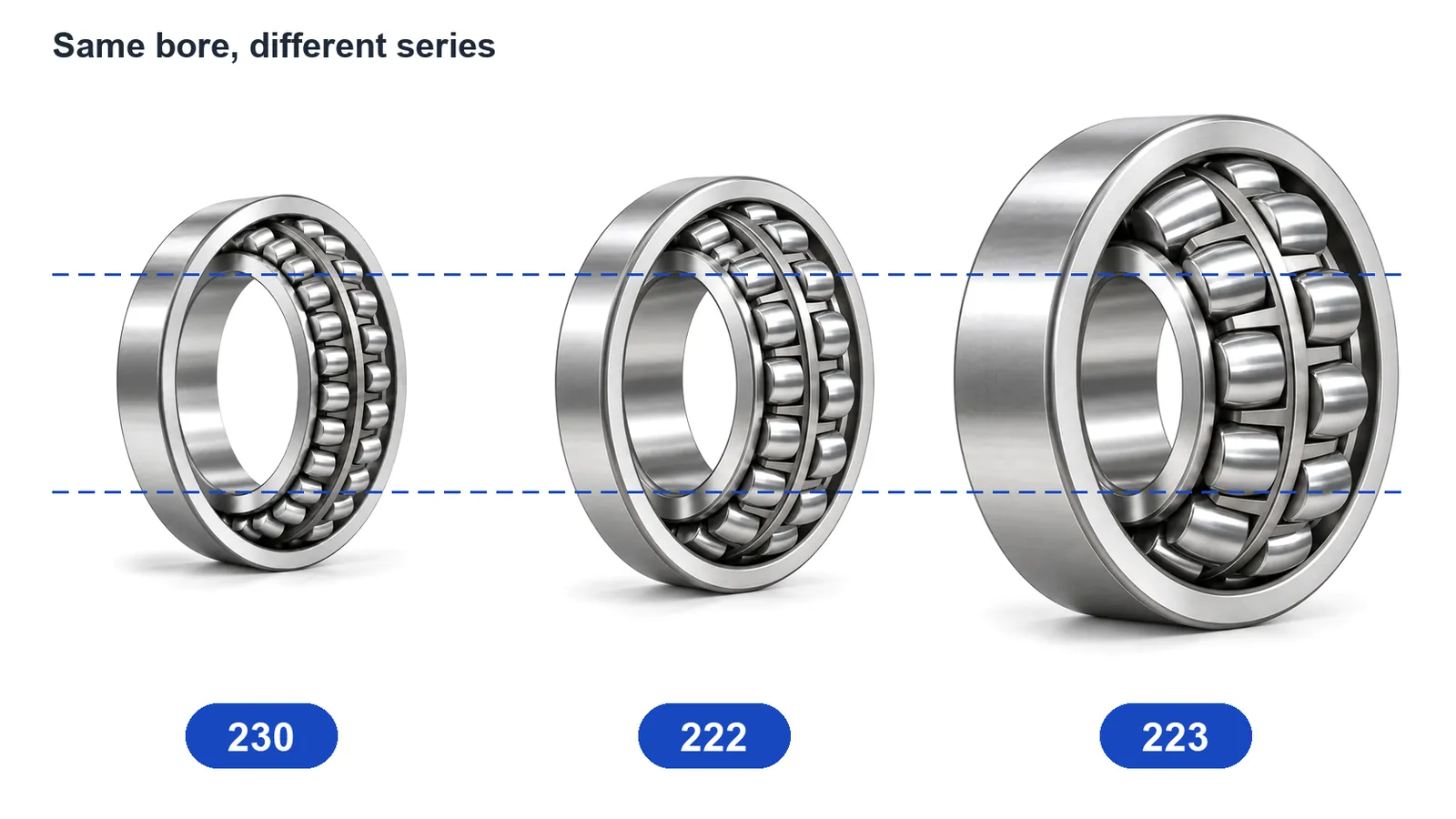
The series code tells you the section of the bearing for a given bore. Series 222 and 223 are the common medium and heavy sections in bores up to about 200 mm; 230, 231, 239 and the 240 and 241 series appear in larger bores where a thinner section is enough. The size chart guide lists the boundary dimension ranges for every series ENRO carries; the table below gives the ISO 15 dimension series that each code stands for.
| Series | ISO 15 dimension series | Width and diameter series | Section |
|---|---|---|---|
| 239 | 39 | Width 3, diameter 9 | Thinnest section; large bore, small load |
| 230 | 30 | Width 3, diameter 0 | Light section |
| 240 | 40 | Width 4, diameter 0 | Light section, wider |
| 231 | 31 | Width 3, diameter 1 | Medium-light section |
| 241 | 41 | Width 4, diameter 1 | Medium-light section, wider |
| 222 | 22 | Width 2, diameter 2 | Medium section; the most common series |
| 232 | 32 | Width 3, diameter 2 | Medium section, wider |
| 213 | 03 | Width 0, diameter 3 | Heavy section, narrow |
| 223 | 23 | Width 2, diameter 3 | Heavy section, wide; highest capacity per bore |
| 238 | 38 | Width 3, diameter 8 | Very thin section, large bore |
| 248 | 48 | Width 4, diameter 8 | Very thin section, wider |
How do you read the bore code?
The bore code is the last two digits before any suffix. Multiply by five for codes 04 to 96. The codes 00 to 03 are fixed at 10, 12, 15 and 17 mm, which is why a 22203 has a 17 mm bore and not 15. From 500 mm the bore is written out after a slash, so 230/500 is a 230 series bearing with a 500 mm bore, and 230/530 would have a 530 mm bore.
| Bore code | Bore d mm | Rule |
|---|---|---|
| 00 | 10 | Fixed values for the four smallest codes |
| 01 | 12 | Fixed |
| 02 | 15 | Fixed |
| 03 | 17 | Fixed |
| 04 to 96 | 20 to 480 | Code × 5, for example 10 → 50 mm, 40 → 200 mm |
| /500 and above | As written | Bore written in millimetres after a slash, for example 230/500 |
What do the suffixes mean?
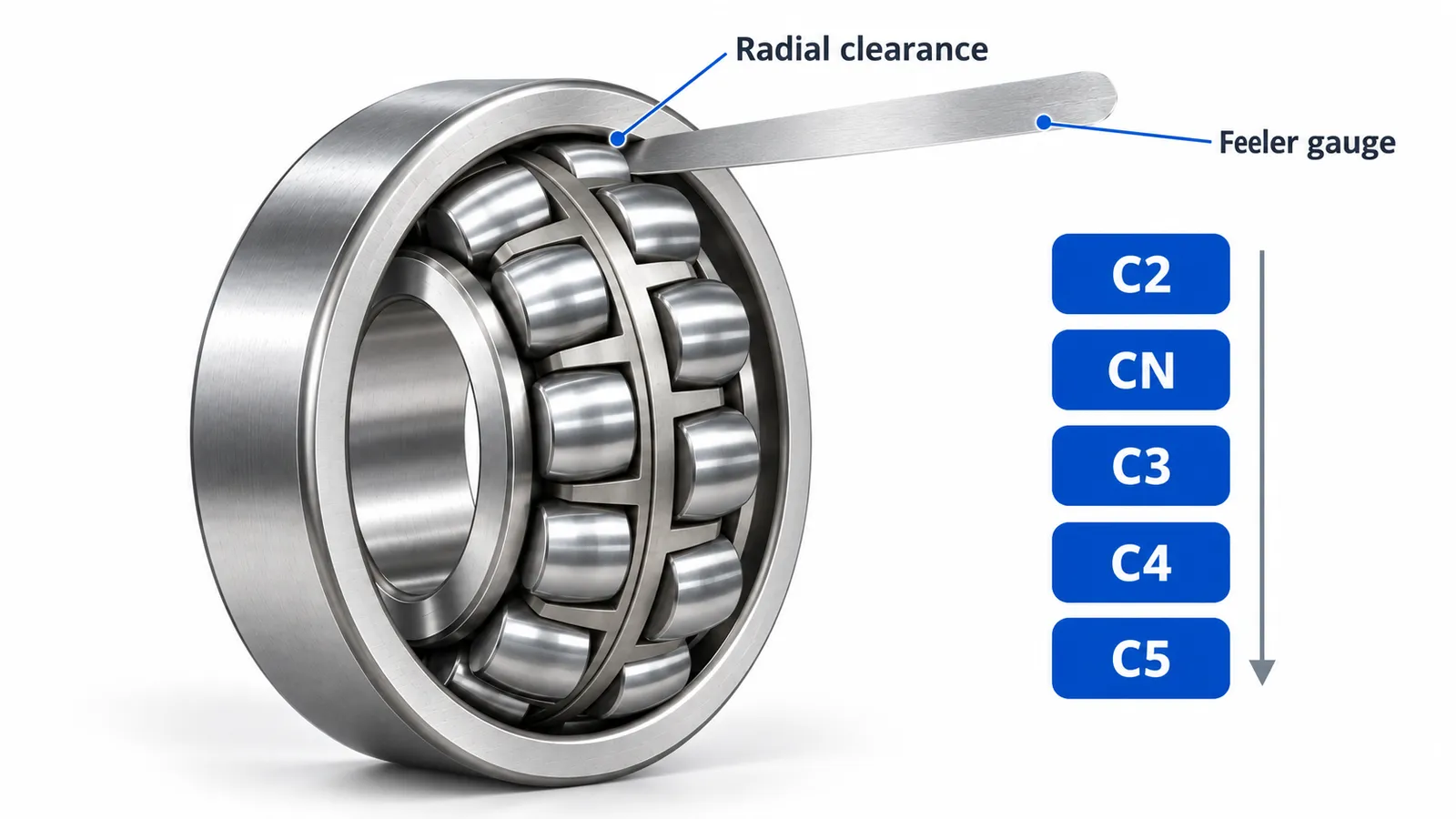
ENRO writes spherical roller bearing designations as the base number, the bore suffix if the bore is tapered, and W33. The three suffixes below are the ones that appear in the ENRO list. Other makers add cage codes (CA, CC, E, MB and similar) and internal design codes; those describe that maker's construction and are not part of the ISO number, so they do not affect interchangeability of the boundary dimensions. Clearance suffixes C2, C3, C4 and C5 follow the clearance chart guide.
| Suffix | Name | Meaning |
|---|---|---|
| K | Tapered bore 1:12 | Tapered bore, taper 1:12, for adapter or withdrawal sleeve mounting. |
| K30 | Tapered bore 1:30 | Tapered bore, taper 1:30, used on wide series such as 240 and 241. |
| W33 | Lubrication groove and holes | Groove and holes in the outer ring for relubrication. |
Use the suffix selector to decide between a cylindrical and a tapered bore: a tapered bore on an adapter sleeve is easier to mount and dismount on a plain shaft and lets you set the clearance by drive-up; a cylindrical bore is used where the shaft has a machined seat and shoulder.
Worked examples from the ENRO list
The three examples below run the rule on real sizes from the ENRO range: a small medium-section bearing, a large medium-light bearing, and a 500 mm bore where the slash notation applies.
| Model | d × D × B mm | Decoding |
|---|---|---|
| 22210 | 50 × 90 × 23 | 222 — bearing type and dimension series code. |
| 50 × 90 × 23 | 10 — bore code: code 10 × 5 = 50 mm. | |
| 23140 | 200 × 340 × 112 | 231 — bearing type and dimension series code. |
| 200 × 340 × 112 | 40 — bore code: code 40 × 5 = 200 mm. | |
| 230/500 | 500 × 720 × 167 | 230 — dimension series code. |
| 500 × 720 × 167 | /500 — for this size the bore is written directly in millimetres: d = 500 mm. |
How do you cross-reference a number from another catalogue?
Strip the number down to its five digits and the K, K30 or W33 suffixes. The five digits fix the boundary dimensions under ISO 15, so the ENRO bearing with the same five digits is dimensionally interchangeable: same bore, same outside diameter, same width. Ignore cage and internal design letters when matching size, but tell us what they were so we can flag any duty the original design was chosen for. The bearing cross reference page walks through this, and the spherical roller bearing page lists every size ENRO offers.
- Same five digits, cylindrical bore: order the ENRO base number with W33, for example 22216.
- Same five digits with K: order the K W33 version; K30 for the 240 and 241 series.
- Number with a clearance suffix: keep it; C3 is the usual group for sleeve mounting.
- Number you cannot decode: send a photograph of the face and the three measured dimensions.
Every ENRO bearing is Made in China and passes 100% outgoing inspection under Japan-managed quality control. Ratings are catalogue reference values, confirmed per batch on request. We reply within 24 hours on business days.
Related ENRO products
Click a model to open its full specification page.